Bonded Manifolds
Solutions & Processes
Bonded Plastic Materials
Manifold Assembly
Machined Plastics
Machining Processes
Support Services
Plastics
Machined Plastic Parts Materials ABS Plastic for Machined Parts & Prototypes Acetal & Delrin MachiningAcrylic Plastic Materials & MachiningCOC/COP Plastic Materials & MachiningCPVC Plastic Material & MachiningCTFE/KEL-F Plastic Material & MachiningDelrin AF Plastic Material & Machining ECTFE/Halar Plastic Material & Machining Fluorosint® 500 and 207 Plastic Materials & MachiningHDPE Plastic Material & MachiningLDPE Plastic Material & MachiningNoryl® Plastic Material & MachiningNylatron GS: Self Lubricating Nylon for Precision MachiningNylon 6/6 Material & Machining PBT Plastic Material & MachiningPEEK Plastic Machining for Medical, Life Science & Aerospace OEMsPES (Radel A) Plastic Material & MachiningPlastic Machining With PETPhenolics/G10 Plastic Machining Polycarbonate Plastic & MachiningPolypropylene Plastic Material & MachiningPolysulfone Plastic Matetial & MachiningPPS Plastic Material & MachiningPVC Plastic & Machining PVDF Plastic Material & MachiningRadel® Plastic Material & MachiningRexolite® Plastic Material & Machining Tecadur Plastic Material & MachiningTeflon® Plastic Machining (PTFE) | Controlled FluidicsTorlon PlasticMaterial & MachiningUHMW Plastic Materials & MachiningUltem® (PEI) Plastic Material & MachiningVespel® Plastic MachiningPOLYMER OPTIONS
Applications
Aerospace
Life Science
Medical & Healthcare
Research & Diagnostic
Military & Defense
Specialized Electronics
Resources
Plastic Manifold Design Guide
Articles & Written Works
White Papers
General Chemical Resistance
Media Kit
Controlled Fluidics Design Gallery
About Us
Our Key Plastics Partners
The Controlled Fluidics Difference
Case Studies & Success Stories
Testimonials
We Are Hiring
Back to the product list

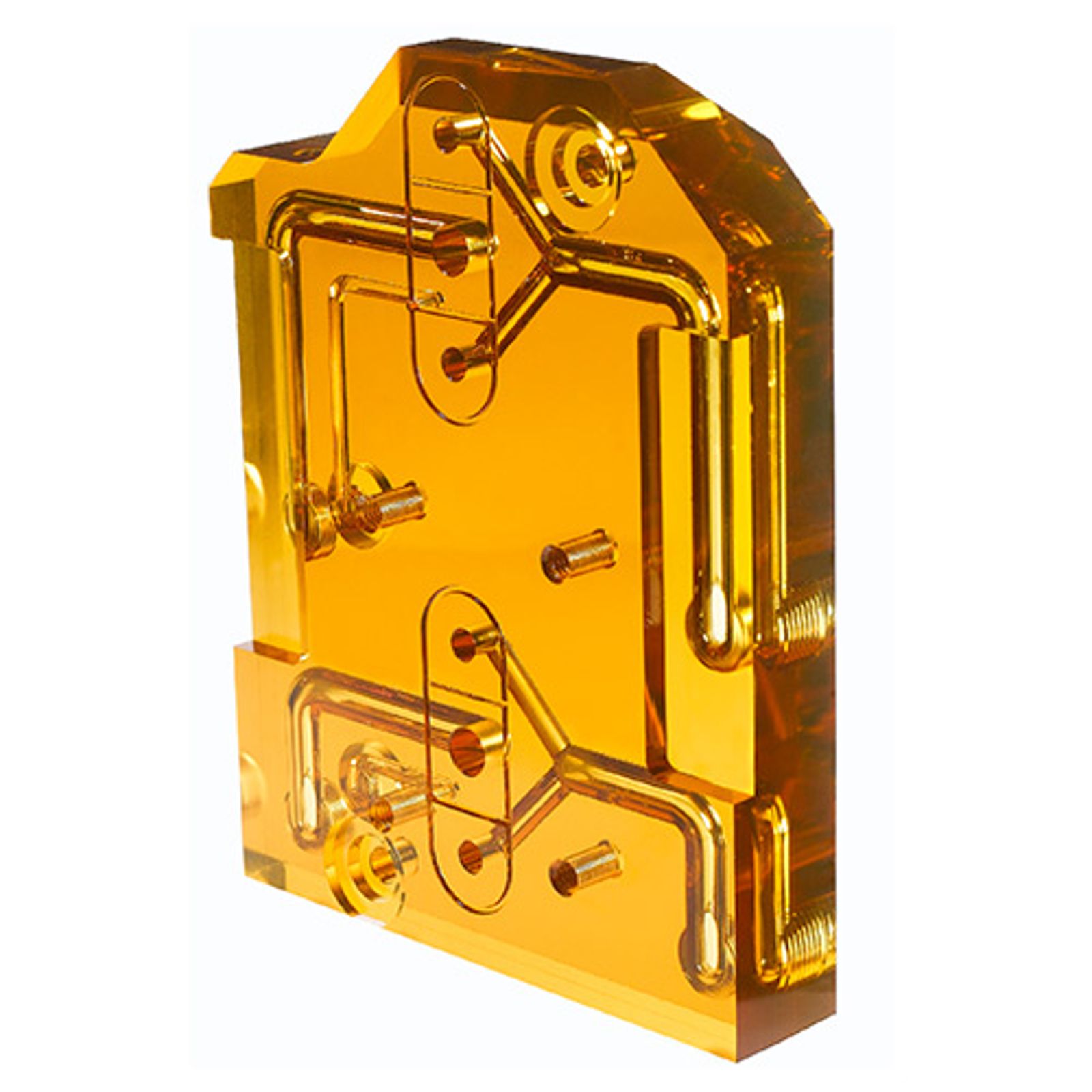
ULTEM BONDED PLASTIC & MANIFOLDS

Due to its high performance and ease of manufacturing, ULTEM® (PEI or polyetherimide) is an excellent choice due to its fantastic electrical properties, high heat and flame resistance, outstanding strength, and ability to take repeated sterilizations. It is utilized in a wide cross-section of manufacturing industries including medical, R&D, aerospace, and automotive. Available with fillers for reinforcement (like glass as found in ULTEM 2300) or other materials to fulfill other necessary product qualities.

Due to its high performance and ease of manufacturing, ULTEM® is an excellent choice for manifolds and reusable plastic components. ULTEM® provides a higher level of performance than their polycarbonate, polysulfone, and acrylic counterparts based on several qualities.

  • High Performance Thermoplastic

Rigid, amorphous resin with high tensile and flexural strength. ULTEM 1000 doesn't have reinforced material like glass, but it still retains great durability and performance.

  • FDA Compliant

For uses that need FDA compliance, ULTEM can meet their rigid standards for medical, pharmaceutical, and diagnostic use.

  • Heat and flame resistance

Performs continuously up to 171°C (340°F) before becoming compromised. Also has a high limiting oxygen index (LOI), and it works to self-extinguish once removed from an ignition source.

  • High dielectric strength & arc resistance

Retains function over wide frequency and voltage range

  • Tolerates high internal channel pressure
  • Capable of glass fiber reinforcement (ULTEM 2300)
  • Versatile & easily machined
  • Recyclable

FOR ULTEM® 1000

Tensile strength (at yield, 23ºC (73ºF))

15,200 to 17,000 psi

Tensile Modulus of Elasticity (at yield, 23ºC (73ºF))

Up to 500,000 psi

Flexural Modulus (of Elasticity)

480,000 to 500,000 psi

Glass Transition Temperature

Stable to 200°C (392°F). Can reach up to 217°C (422°F).

Continuous Service Temperature in Air

165°C (330°F) to 171°C (340°F)

Heat Deflection Temperature (@ 264 psi)

200°C (392°F) to 204°C (400°F)

VO Flammability

UL-94

ULTEM® can be difficult to see through, especially if the manifold is over 1 inch thick. The material can start as a very dark amber and can look "blacker" the thicker or more layers a component gets. This unfortunately makes channel and internal feature inspection difficult.

Round, square, and singled-sided D-channels are all possible to 0.020 inches. Internal pressures to 150 psi are possible, depending on channel size. Large cavities and bonded-in components are available, but the design must be high-heat tolerant.

A note about cost: ULTEM® also costs much more than other plastic resins that manufacturers process, usually doubling the cost of acrylic. Multi-layer designs increase costs sharply after two layers.