Bonded Manifolds
Solutions & Processes
Bonded Plastic Materials
Manifold Assembly
Machined Plastics
Machining Processes
Support Services
Plastics
Machined Plastic Parts Materials ABS Plastic for Machined Parts & Prototypes Acetal & Delrin MachiningAcrylic Plastic Materials & MachiningCOC/COP Plastic Materials & MachiningCPVC Plastic Material & MachiningCTFE/KEL-F Plastic Material & MachiningDelrin AF Plastic Material & Machining ECTFE/Halar Plastic Material & Machining Fluorosint® 500 and 207 Plastic Materials & MachiningHDPE Plastic Material & MachiningLDPE Plastic Material & MachiningNoryl® Plastic Material & MachiningNylatron GS: Self Lubricating Nylon for Precision MachiningNylon 6/6 Material & Machining PBT Plastic Material & MachiningPEEK Plastic Machining for Medical, Life Science & Aerospace OEMsPES (Radel A) Plastic Material & MachiningPlastic Machining With PETPhenolics/G10 Plastic Machining Polycarbonate Plastic & MachiningPolypropylene Plastic Material & MachiningPolysulfone Plastic Matetial & MachiningPPS Plastic Material & MachiningPVC Plastic & Machining PVDF Plastic Material & MachiningRadel® Plastic Material & MachiningRexolite® Plastic Material & Machining Tecadur Plastic Material & MachiningTeflon® Plastic Machining (PTFE) | Controlled FluidicsTorlon PlasticMaterial & MachiningUHMW Plastic Materials & MachiningUltem® (PEI) Plastic Material & MachiningVespel® Plastic MachiningPOLYMER OPTIONS
Applications
Aerospace
Life Science
Medical & Healthcare
Research & Diagnostic
Military & Defense
Specialized Electronics
Resources
Plastic Manifold Design Guide
Articles & Written Works
White Papers
General Chemical Resistance
Media Kit
Controlled Fluidics Design Gallery
About Us
Our Key Plastics Partners
The Controlled Fluidics Difference
Case Studies & Success Stories
Testimonials
We Are Hiring
Back to the product list

PEEK Plastic Machining for Medical, Life Science, and Aerospace OEMs

High‑performance PEEK machined parts and drilled manifolds for implants, surgical instruments, and high‑temperature aerospace components


PEEK (polyetheretherketone) is another type of "powerhouse plastic" due to its many qualities. As a high-performance thermoplastic, its semi-crystalline structure and molecular structure give this material a breadth of applications in the medical, life sciences, and other industries. It's a stable, easy-to-machine, and heat resistant plastic that can withstand aggressive chemical environments, extreme temperatures, and constant wear and tear. This also grants its status as one of the few materials typically approved by the FDA for continuous and safe use in the human body. USP Class 6 as well as implant grades are available.

However, PEEK plastic is not a bondable material. Due to this, PEEK manifolds are made through plastic drilling or other machining processes.

  • Tight‑tolerance PEEK machined parts can be down to ±0.005 in for critical components.

  • USP Class VI and implant‑grade PEEK options for long‑term contact and implants.
  • Design support for non‑bondable PEEK manifolds using drilling and porting strategies.

KEY FACTS ABOUT PEEK


Temperature & Sterilization

Mechanical Strength & Wear

Chemical Resistance

Biocompatibility & Regulatory 

Exceptional thermal stability

Excellent mechanical strength

Highly chemical resistant

Biocompatible with human biology

Continuous exposure to temperatures up to 250°C (482°F)

High dimensional stability

Pigment receptive

FDA & implant grades available 

Glass transition temperature (Tg): 143°C (289°F)

Great creep resistance

Resistant to most organic and inorganic chemicals 

Aerospace grades available 

Melting point: 343 °C (662 °F)

Superior electrical insulation

Supports use in aggressive reagents and cleaning chemicals

USP Class VI available  

Able to withstand high-temp sterilization methods 

High dielectric strength


Low friction coefficient


Easily machined


PROPERTIES & CHARACTERISTICS

Belonging to the family of materials known as polyaryletherketones (PAEK), PEEK itself carries many of the family's prime properties. Known for its several types of resistance to certain elements, teams commonly choose PEEK plastic because of its tolerance for intense and harsh operating environments. Regarding its high temperature resistance, the material can withstand continuous exposure to temperatures as high as 250°C (482°F) without harming the material's structure. It can also handle limited exposure up to 300°C (572°F) without seriously compromising its mechanical properties. Constant exposure to hot liquid or steam usually does not affect the plastic's integrity, making some PEEK grades sterilizable in autoclaves and other steam sterilization methods. However, it does have a lower heat deflection temperature of around 152°C (~306°F). A PEEK machined part still retains its function in that range, but will likely lose some of its strength due to softening.

Delving more into its mechanical properties, the material exhibits excellent strength, stiffness, and dimensional stability. Due to these qualities, engineers have marked its high tensile strength and modulus with a low friction coefficient that make it a preferred material for structural applications. It can take abrasive and extended use in this regard. That combined with its low moisture absorption makes this material's performance consistent even in wet or humid environments.

Considering its many chemical resistances, PEEK stands out. Its high resistance to most organic and inorganic chemicals (except for concentrated nitric and sulfuric acids) make it particularly attractive to those in medical and life science. For a comprehensive list of how it performs against certain chemical types, visit our chart. If interested in seeing the resin's performance against those chemicals used in life science,  we have a chart for that as well.

When To Choose PEEK?

Select PEEK when you need an easy to work with plastic that can reliably perform at high temperatures continuously and resist harsh chemicals while retaining biocompatibility in one material.  

If you also need a material that is very stable, PEEK can achieve ± 0.0005" tolerances and overall surface finish of 32 μ", typically porting to 16 μ". Due to PEEK's high tensile strength, thread inserts are generally not necessary except for high assembly and disassembly situations.

Use PEEK for components that won't need bonding and where drilled channels are acceptable. 

Material

Typical Strengths

Best For

PEEK

High temperature, chemical resistance, biocompatibility, high tensile strength.

Implants, sterilizable manifolds, aerospace and defense components.

PEI / ULTEM

High temperature and rigidity, good dielectric properties.

Electrical housings, structural enclosures, high‑temp fixtures.

Standard acetal

Good machinability, lower cost, good wear.

General purpose bushings, gears, and structural components where extreme conditions are not present.


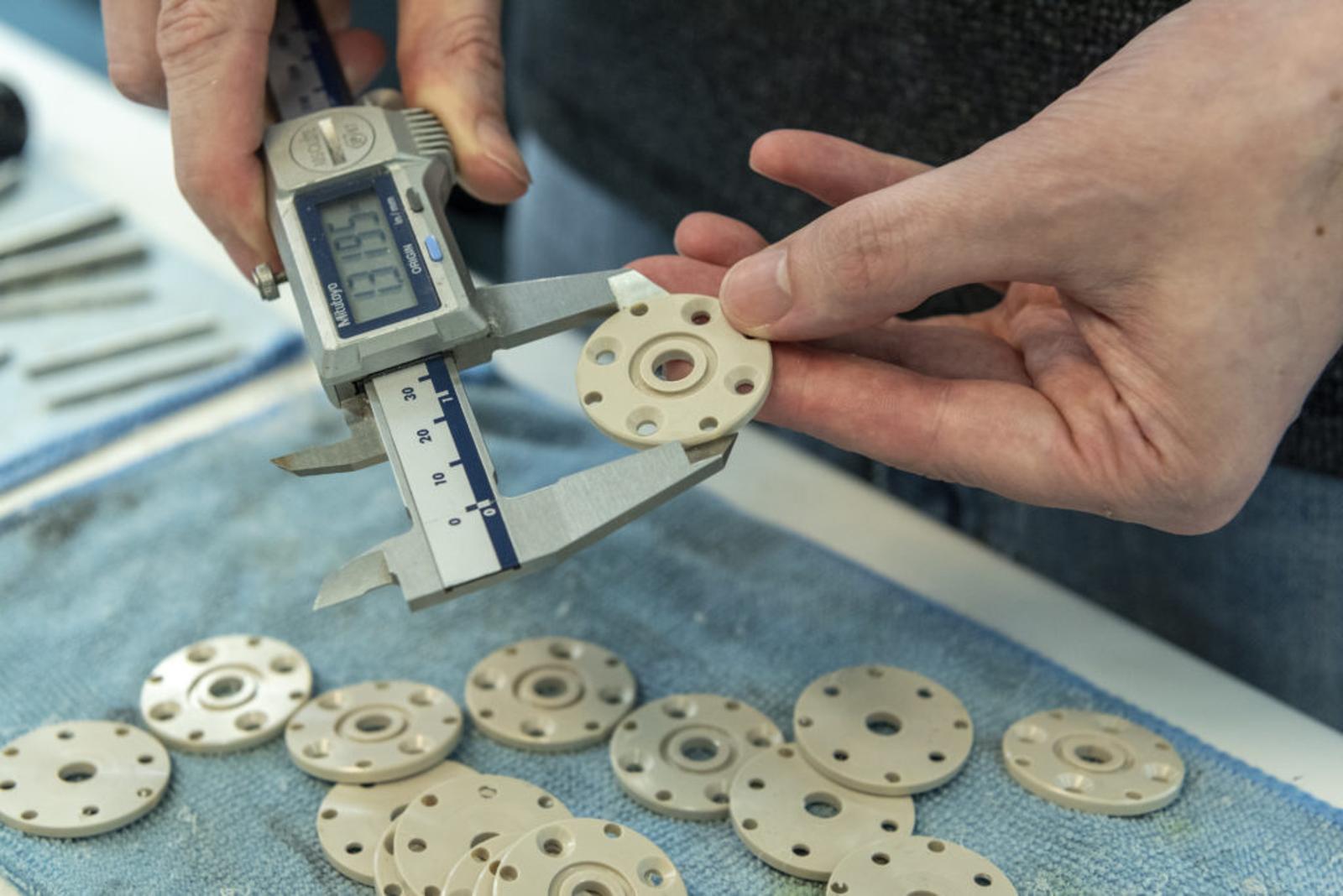
A person uses digital calipers to measure the diameter of a round, beige PEEK plastic part with holes, while several similar parts are spread out on a blue cloth below.

Design & Machining Guidelines

When working with PEEK, we have some design suggestions:

  • Manufacturers cannot bond this plastic and will instead create manifolds through drilling only.
  • Pay attention to intersecting holes for burrs. Proper tooling is critical for the component to serve its purpose.
  • Stress-relieved parts are only necessary for exacting applications, but the plastic is not stress-sensitive.
  • The material (once finished) can have a mottled look, especially in the non-450g version.
  • Sheet material comes + .030. Design parts to avoid the next size up as that increases cost.

Some varieties of PEEK are made with pre-qualified biocompatible materials and are FDA approved, making them ideal options for life science applications. It is one of the few biologically safe materials for continuous use in the human body. Due to this, we find it often used in products like implants and dental applications to enhance product longevity and effectiveness.

Although the life sciences and medical find this resub a choice material, other industries find uses for it as well. For example, industries serving aerospace and defense recognize its durable nature and create products that need to withstand harsher environments. With PEEK's high continuous use temperature, this quality makes it stand out from other options fairly often. The same goes for industries in oil/gas, automotive, and several others.

PEEK comes widely available in different forms. Sheets, rods, and tubes come as extruded products usually in its natural tan or black state, if requested. The material can also come as a translucent or clear film when in an amorphous state. Tubing is available in an array of small diameter products to fit several purposes. Plates and rods are available in both metric and imperial sizes. Additionally, we can gain the material in several different grades: general-purpose unfilled machine grade, USP class VI (6) grade, and implant grade. PEEK can also be reinforced with structural fillers, such as glass fiber or others to increase PEEK's mechanical properties.

Peek-plastic-machining-3.jpg

We need to make a note here about cost when it comes to PEEK plastic. While the plastic is usually a more expensive material than others we use, engineers need to weigh the benefits to the cost. If there is a more cost effective material that will suit with maybe fewer features, we suggest that route if cost is of great concern. However, if it's not as largely influential, its many benefits will pay for itself long term.

You may be wondering if its price will fall and to wait. To give some background, we can only guess where its prices will fall when you get a quote for your project. This is because initially, it was only available from Victrex with their unfilled resin number known as 450g. Though lately additional manufacturers are competing in the marketplace, which helps to improve the price point. Rest assured that we are always on the lookout for the best prices that don’t sacrifice any quality. And here's our secret on how we do that: through our esteemed partners at Quantum Plastics. Our special partnership grants us access to more direct pricing that we pass on to you, but this is for Controlled Fluidics clients and customers only.

Aside from cost considerations, PEEK does have some disadvantages. Its low resistance to UV light and the need to process it at high temperatures could cause some reservations in choosing this material. Also, in medical applications, the material's hydrophobic, nonpolar nature means it has rudimentary cell adhesion. If any of these cause pause, we encourage your exploration of other materials.